
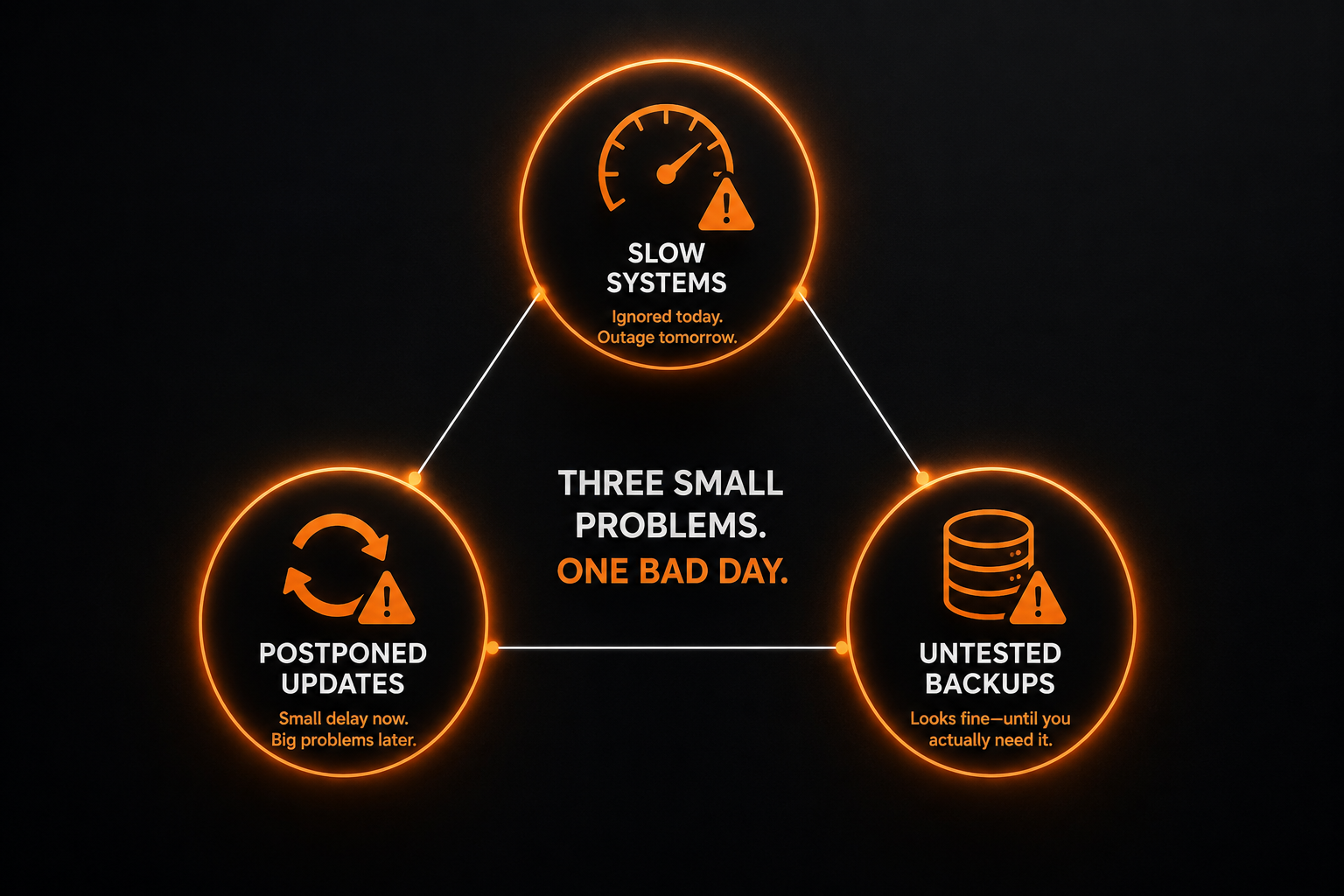
The Three IT Problems Everyone Postpones Until They Can’t
Nothing’s broken. That’s exactly the problem.
The most expensive IT problems we get called about almost never start with something dramatic. They start with something small that worked well enough to ignore.
A system runs a little slower than it used to. A warning shows up and then goes away. An update gets postponed because there’s never a good time. None of it stops the day, so it gets pushed to “next week” and stays there.
Then next week becomes next month, and one Tuesday morning, all three of those small things show up at once.
The “it’s just a little slow” system
This is the most common one. A piece of software, a server, a shared drive — something starts taking longer than it used to. Not enough to file a ticket. Just enough that everyone adjusts. People wait an extra few seconds, hit refresh twice, and learn to start their coffee while the program loads.
The slowness becomes part of the routine, which means nobody questions it anymore. Until one day it stops loading entirely.
Now nobody can access the system. Your team starts troubleshooting on their own — restarting machines, guessing at causes, calling each other to ask if it’s just them. The person who usually deals with this stuff is on vacation, or out at a job site in Goshen, or just genuinely doesn’t know what changed. What could have been a quick fix two months ago is now a half-day outage.
The update that keeps getting postponed
Every business has one. There’s an update that should have been installed in March, then in April, then “after this big project is done.” There’s always a reason it’s not a good time.
Because nothing is actively broken, the update doesn’t feel urgent. It feels like maintenance, which is the kind of thing that’s easy to push when you’ve got customers to serve and payroll to run.
Eventually, one of two things happens. Either the system you postponed updating becomes incompatible with something else you rely on, or you’re scrambling to do an update under pressure. Or the vulnerability the update was supposed to fix gets exploited, and you’re not doing maintenance anymore — you’re doing damage control.
Neither of those is the kind of project you want to handle in the middle of a normal workweek.
The backup nobody’s actually tested
This one is the quietest, which is what makes it the worst.
Backups run in the background. They’re supposed to. As long as nothing fails, there’s no reason to think about them. Maybe there was a warning notification six months ago that didn’t seem urgent, or a configuration change that nobody followed up on. Since the day-to-day kept working, the assumption was that the backups were fine too.
The first time anyone actually finds out is when something breaks. A drive fails, a file gets deleted, ransomware hits — and now the backup needs to do the one job it exists to do. That’s an awful moment to discover it’s been silently failing for three months.
A backup that hasn’t been tested isn’t really a backup. It’s an assumption.
What proactive support actually does
The difference between businesses that get caught off guard and the ones that don’t isn’t luck. It isn’t even a budget. It’s whether somebody is watching the small stuff before it becomes the urgent stuff.
For us, that means monitoring systems in the background and catching the slow login before it turns into a failed login. Running updates on a schedule we control, not under pressure when something breaks. Testing backups regularly, so when you actually need to restore something, the restore works.
It’s not glamorous work. Most of it is invisible by design. You only notice it when you compare a year of running this way to the way things used to be — and realize you haven’t had a fire drill in a while.
Before something forces your hand
If you’ve got a couple of things sitting in the back of your mind right now — a system that’s been slow for a while, an update you keep meaning to do, a backup nobody’s verified — you’re not alone. Most businesses in Marshall County and across Northern Indiana have at least one of those running in the background.
The honest answer is that those things almost always come due at the worst possible time.
If you’d like someone to look at what’s been sitting on the list and figure out what’s actually urgent versus what can wait, book a quick call: http://os.lecsit.com/l/disoverycall-june-2026-blog. Or call us at 574-857-4332.